The Real Outfit Count
A pairing grid for the outfits your wardrobe really makes: shoes and layers row by row, dresses on their own line, the pieces that pair with almost nothing, the days it covers between washes, and a test for anything new before you buy
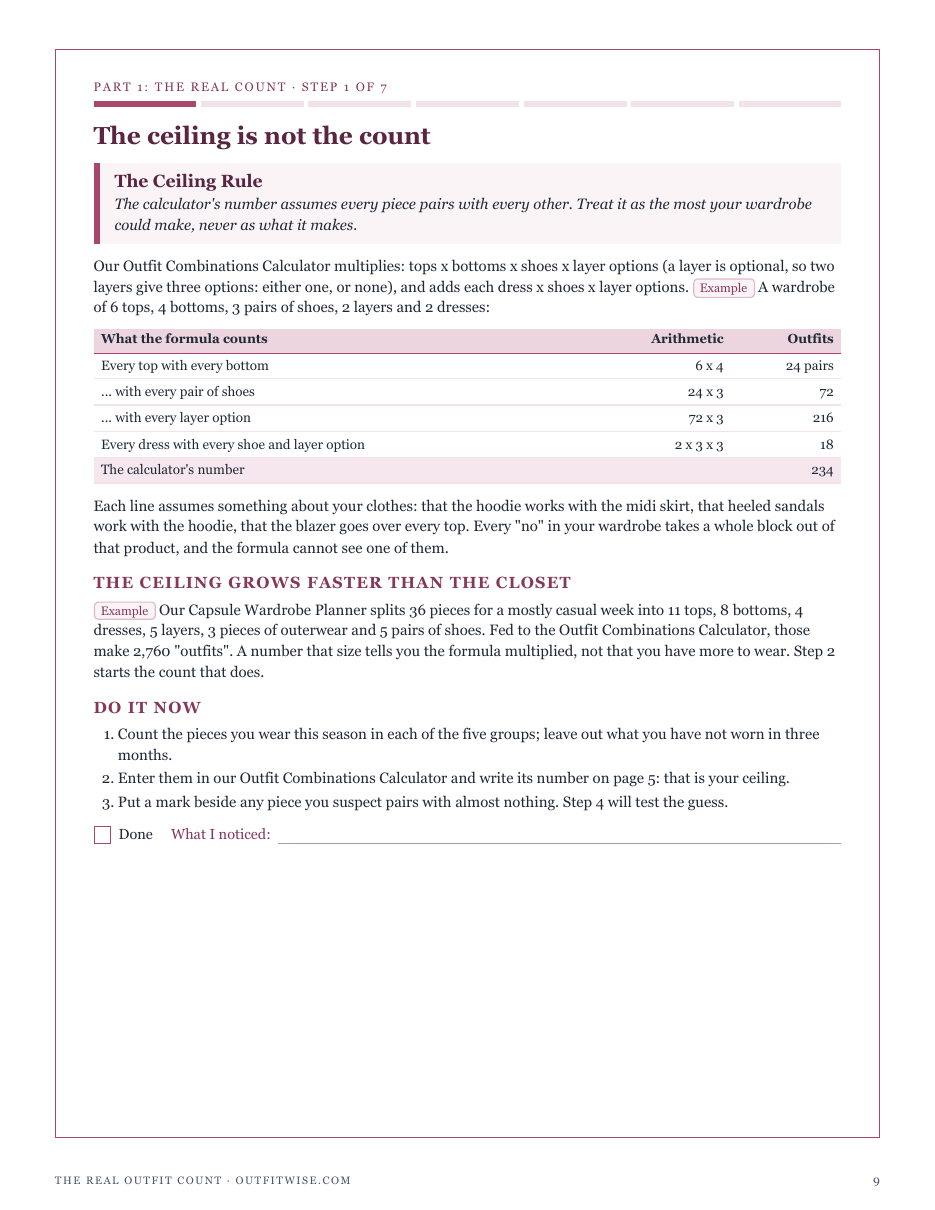
OutfitWise's Outfit Combinations Calculator multiplies tops by bottoms by shoes by layer options, which is right only if every piece pairs with every other. No real wardrobe works that way, and nothing on the site counts the outfits you would actually wear, checks a capsule against the days between your washes, or prices a new piece by what it adds. The pack does that on a pairing grid. Mark only the top and bottom pairs you would leave the house in, write the shoes that work in each square, multiply each row by the layers that go over that top, and count dresses on their own line. Example: six tops, four bottoms, three pairs of shoes, two layers and two dresses make 234 outfits on the calculator and 103 on the grid (44%). Then set the real count against your wash (that wardrobe covers 8 days between 7-day washes) and test anything new: a sequin top the calculator credits with 36 new outfits adds 2, at $30.00 each, while a $45 white shirt adds 27. Finally, price a piece with its alterations and care: a $180 blazer worn 40 times is $4.50 a wear on the tag and $7.53 with $25 of alterations and dry cleaning. It is not a style guide or a color analysis (seasonal color analysis is a styling convention, treated only as a preference), it says nothing about bodies, and it names no brands. Every figure is an example computed by our calculators' own code. Included: 7 steps, a pairing grid, a dress and orphan sheet, a wash and season sheet, buy test cards, reference tables, a quickstart, and a personalised sheet worked from the numbers you enter in our calculators.
Look inside
Two full pages from the pack, exactly as printed. Click either to read it at full size before you decide.
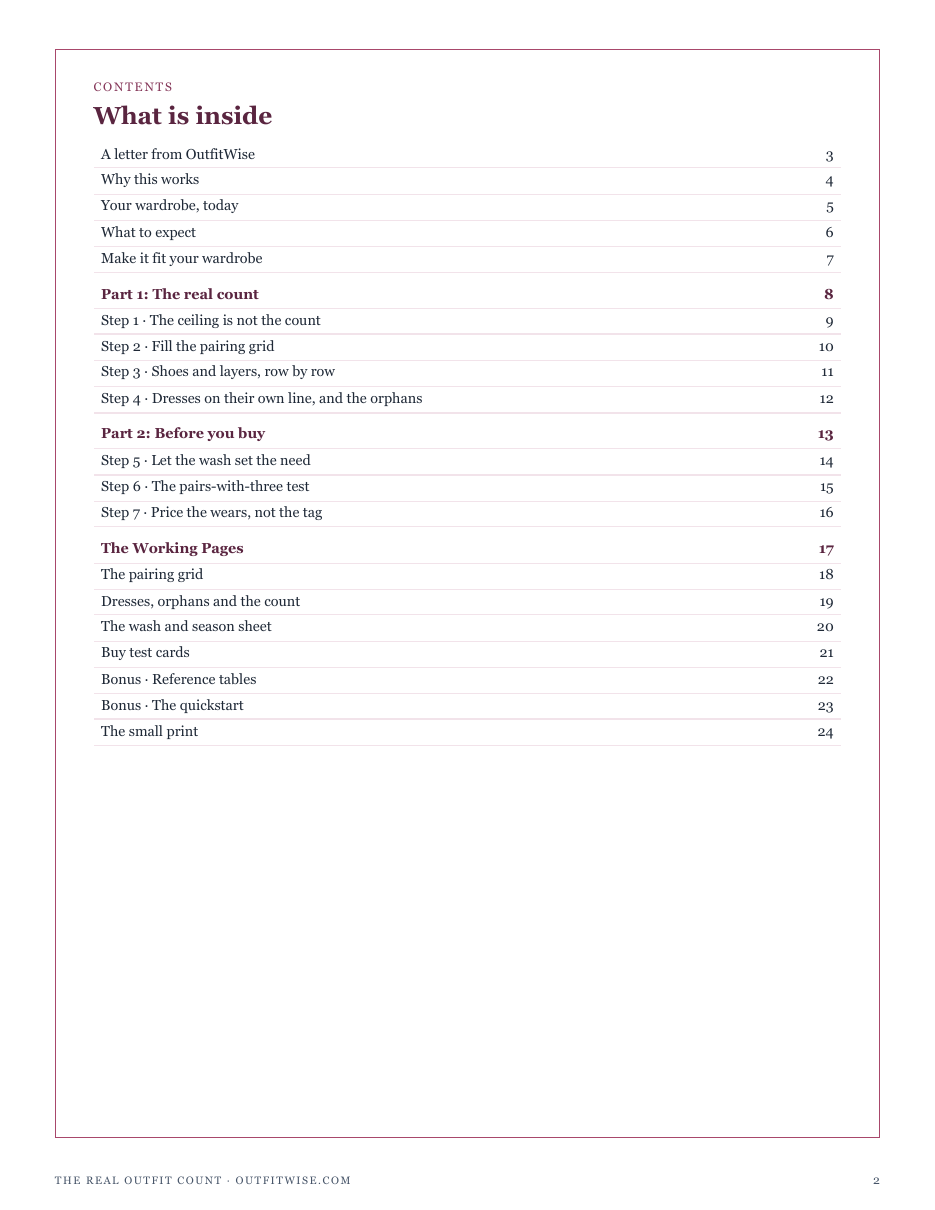
What is in it
- Step 1: the ceiling: what the Outfit Combinations Calculator multiplies, and what every line of it assumes
- Step 2: the pairing grid: only the top and bottom pairs you would leave the house in
- Step 3: shoes in each square and each row multiplied by its own layer options
- Step 4: dresses and one-pieces on their own line, the real count beside the ceiling, and the orphans named
- Step 5: the days your wardrobe covers between washes, the season against the real count, and the Capsule Wardrobe Planner's split against both
- Step 6: the pairs-with-three test: what one more piece adds to your real count, and its price per outfit added
- Step 7: the full price per wear, with alterations and care; no wears, no answer
- Working pages: a pairing grid, a dress and orphan sheet, a wash and season sheet, and buy test cards
- Reference tables: how fast the ceiling grows, cost per wear with and without care, and the arithmetic on one card
- A personalised sheet worked from the numbers you enter in the Outfit Combinations Calculator, the Capsule Wardrobe Planner and the Cost Per Wear Calculator
- ✓ 24 printable pages
- ✓ 10 sections, worksheets and templates
- ✓ A second PDF worked out from the numbers you enter
- ✓ No account needed, just an email address
- ✓ Instant download; link valid 7 days
Price includes any taxes. Sold by GrabURL, who handle checkout and support. The charge appears on your statement as GrabURL.
The pack picks up where the free Outfit Combinations Calculatorleaves off. Its number multiplies tops by bottoms by shoes by layers, which is only true if every piece pairs with every other; the pack's pairing grid counts only the pairs you would actually wear, row by row, with dresses on their own line. Then it checks the days your wardrobe covers between washes against the Capsule Wardrobe Planner's split, tests anything new by the outfits it adds to your real count, and prices it per wear with alterations and care, which the Cost Per Wear Calculator leaves out. It is not a style guide or a color analysis, it says nothing about bodies, and it names no brands. Every figure in it is an example for you to replace.